

Modbus to LoRaWAN® controller - RS485 remote data acquisition: UC100 | Milesight

Compact LoRaWAN® IoT controller for RS485 Modbus RTU devices, supporting remote data acquisition, control, local storage and retransmission.
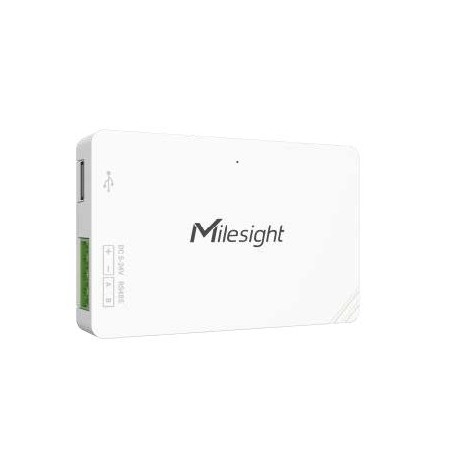
The UC100 is a compact IoT controller designed for remote control and data acquisition from Modbus RS485 devices through LoRaWAN® networks. It can read up to 32 Modbus RTU devices and supports Modbus transparent transmission between the server and RS485 devices, operating as a Modbus to LoRaWAN® converter.
The UC100 is intended for indoor applications where existing RS485 equipment needs to be connected to a long-range wireless IoT network. It supports multiple trigger conditions and actions, allowing autonomous operation even when the network connection is interrupted.
Combined with the Milesight Development Platform, the UC100 enables web-based monitoring and control of remote assets in applications such as smart metering, smart cities and building automation.
Advantages
- Modbus RS485 integration: connects Modbus RTU devices to a LoRaWAN® network.
- Multi-device reading: supports reading up to 32 Modbus registers and connection of up to 32 Modbus devices.
- Long-range wireless transmission: up to 15 km line of sight.
- Autonomous operation: supports multiple triggering conditions and actions.
- Improved reliability: embedded watchdog for stable device operation.
- Data protection: local historical data storage with retransmission to help prevent data loss.
- Low-latency control: supports Milesight D2D protocol for direct control without a LoRaWAN® gateway.
- Remote maintenance: supports Firmware Update Over the Air, FUOTA.
Key Features
- Wireless technology: LoRaWAN® and Milesight D2D.
- LoRaWAN® mode: OTAA / ABP Class C.
- Frequency bands: CN470, IN865, EU868, RU864, US915, AU915, KR920 and AS923 variants.
- RS485 interface: 1 × RS485 port.
- Connector: 2-pin 3.5 mm terminal block.
- Terminal resistor: 1 × 120 Ω resistor switch.
- Baud rate: 1200 to 115200 bps.
- Protocols: Modbus RTU and passthrough.
- Configuration: USB Type-C or downlink.
- Advanced functions: threshold alarm, change alarm, data storage, data retrievability, data retransmission, Milesight D2D Controller, Milesight D2D Agent, IF-THEN command and FUOTA.
- Local storage: up to 800 entries.
- Power supply: DC 5-24 V by power connector or DC 5 V / 1 A by USB Type-C port.
- Power consumption: less than 0.5 W.
- Ingress protection: IP30.
- Operating temperature: -20°C to 60°C.
- Dimensions: 70 × 45 × 13 mm, connectors excluded.
- Installation: desktop or wall screw mounting.
| Feature | UC100 | UC100 EA |
|---|---|---|
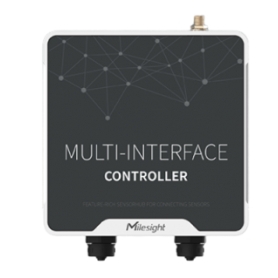
| Antenna | Internal antenna | External antenna version with 50 Ω SMA connector |
| Wireless technology | LoRaWAN®, Milesight D2D | LoRaWAN®, Milesight D2D |
| Data interface | 1 × RS485 | 1 × RS485 |
| Protocol | Modbus RTU, passthrough | Modbus RTU, passthrough |
| LoRaWAN® mode | OTAA / ABP Class C | OTAA / ABP Class C |
| Installation | Desktop or wall screw mounting | Desktop or wall screw mounting |
Typical Applications
- Smart metering: remote acquisition from Modbus RS485 meters.
- Building automation: integration of RS485 equipment into LoRaWAN® monitoring networks.
- Smart cities: wireless supervision and control of distributed assets.
- Industrial monitoring: Modbus RTU data transfer from local equipment to remote platforms.
- Remote asset control: IF-THEN commands and trigger-based actions for autonomous operation.
Why choose UC100
The UC100 is a practical solution for connecting indoor Modbus RS485 devices to a LoRaWAN® infrastructure without replacing existing field equipment. Its support for Modbus RTU, passthrough transmission, local data storage, retransmission and trigger-based automation makes it suitable for reliable data acquisition and control in smart building, metering and infrastructure monitoring projects.
For Canadian IoT deployments, ES Canada can support the selection of the appropriate UC100 version according to antenna requirements, LoRaWAN® network architecture, RS485 communication constraints and integration with existing monitoring systems.