
Temperature, humidity and air pressure probe : Senstick SMC30
PRICE ON REQUEST

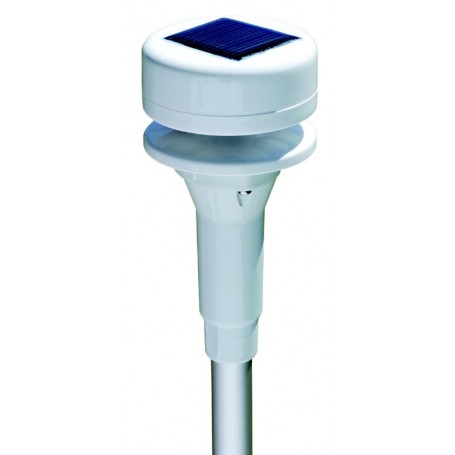


The SONIC-ANEMO-DZP solar-powered ultrasonic anemometer measures wind speed and direction without external power. Features Davis compatibility, a LiFePO4 battery and 480-hour autonomy in complete darkness.
The SONIC-ANEMO-DZP is a solar-powered ultrasonic anemometer and wind vane designed for autonomous wind speed and direction monitoring. Equipped with an integrated photovoltaic panel and LiFePO4 battery, it provides a self-powered measurement solution for weather monitoring installations where electrical consumption is a critical consideration.
Designed for integrators of autonomous weather stations and experienced users, the SONIC-ANEMO-DZP connects directly to compatible pulse and potentiometer inputs, including those used by Davis weather stations and other analog data loggers. Its compact design and included 12 m cable simplify integration into meteorological monitoring systems.
The SONIC-ANEMO-DZP measures instantaneous wind speed and direction using ultrasonic sensing technology. It is specifically intended for autonomous meteorological installations requiring a wind sensor that operates independently of an external electrical power supply.
With its analog-compatible outputs, the sensor can be integrated into suitable existing weather station architectures without requiring a dedicated digital communication interface.
| Parameter | Specification |
|---|---|
| Model | SONIC-ANEMO-DZP |
| Measurement technology | Ultrasonic wind measurement |
| Wind speed output (WS) | Open collector, 10 mA max. |
| Wind direction output (WA) | 25 kΩ, 5 V max. |
| Transmitted information | Instantaneous wind speed and direction angle |
| Refresh rate | 1 measurement and refresh per second |
| Wind speed sensitivity | 0.25 m/s |
| Wind speed resolution | 0.05 m/s |
| Wind speed measurement range | 0.12 to 40 m/s |
| Wind direction sensitivity | ±1.5° |
| Wind direction resolution | 1° (9 bits) |
| Power supply | Photovoltaic panel and LiFePO4 battery |
| Autonomy | 480 hours in complete darkness |
| Solar irradiance for autonomous operation | From 50 W/m² |
| Operating temperature | -15°C (frost-free) to +55°C |
| Cable | 12 m included, 4 × 0.18 mm², UV-resistant |
| Connection | RJ11 |
| Sensor head weight | 180 g |
| Complete assembly weight | 240 g |
| Mounting arm | Vertical, 310 mm, aluminium, Ø16 mm |
The SONIC-ANEMO-DZP is intended for integration into compatible analog weather monitoring systems. Before selection, the following parameters should be considered:
Does the SONIC-ANEMO-DZP require an external power supply?
No. The sensor is equipped with an integrated photovoltaic panel and LiFePO4 battery for autonomous operation.
Can the SONIC-ANEMO-DZP operate without sunlight?
Yes. It provides a specified autonomy of 480 hours in complete darkness.
Is the SONIC-ANEMO-DZP compatible with Davis weather stations?
Yes. It is designed for compatibility with Davis and other analog data loggers using suitable pulse and potentiometer inputs. Electrical and connection compatibility should be verified for the intended equipment.
What does the sensor measure?
The sensor measures instantaneous wind speed and direction, with a wind speed measurement range of 0.12 to 40 m/s and a direction resolution of 1°.
The SONIC-ANEMO-DZP combines ultrasonic wind measurement, solar-powered autonomy and analog data logger compatibility in a compact weather sensor.
Its integrated photovoltaic power system, extended operation without sunlight and direct connection to compatible pulse and potentiometer inputs make it particularly suitable for autonomous meteorological stations and OEM weather monitoring applications.
ES Canada assists technical users and system integrators in selecting ultrasonic wind sensors according to their measurement requirements, electrical interfaces, power autonomy and installation conditions.


