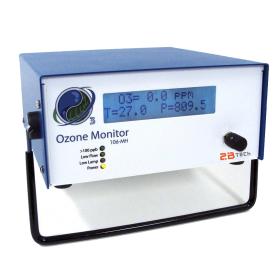
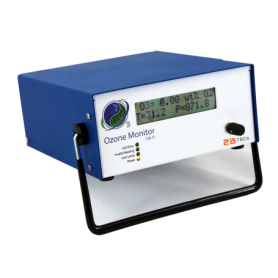
Industrial Ozone Monitor - 0–10,000 ppm: Model 106-MH
PRICE ON REQUEST



2B Technologies Model 108-L is a compact UV absorption ozone monitor for ambient measurements and integration into industrial ozone systems.
2B Technologies Model 108-L is a compact UV absorption ozone monitor for ambient measurements and integration into industrial ozone systems.
The Model 108-L provides accurate measurements of ozone in air over a wide dynamic range extending from a few parts-per-billion by volume (ppb) to an upper limit of 100 parts-per-million (ppm) based on the well-established technique of absorption of ultraviolet light at 254 nm.
Its low power consumption (~2 watts) as well as its minimal maintenance allows the Model 108-L ozone monitor to be used for ambient ozone monitoring and ozone monitoring/control in industrial environments :
It is certified by FEM: EQOA-0914-218. The Model 108-L Ozone Monitor may be used by states and other monitoring agencies under 40 CFR Part 58, Ambient Air Quality Surveillance, for monitoring for compliance with the Clean Air Act. The Model 108-L is available with an optional housing that includes a miniature air pump, or in our specially designed AQLite package for monitoring ambient air.
Match the ozone concentration range and sampling arrangement to the application. Check sample flow, measurement interval and output interfaces, and confirm the exact configuration of the instrument being supplied.