



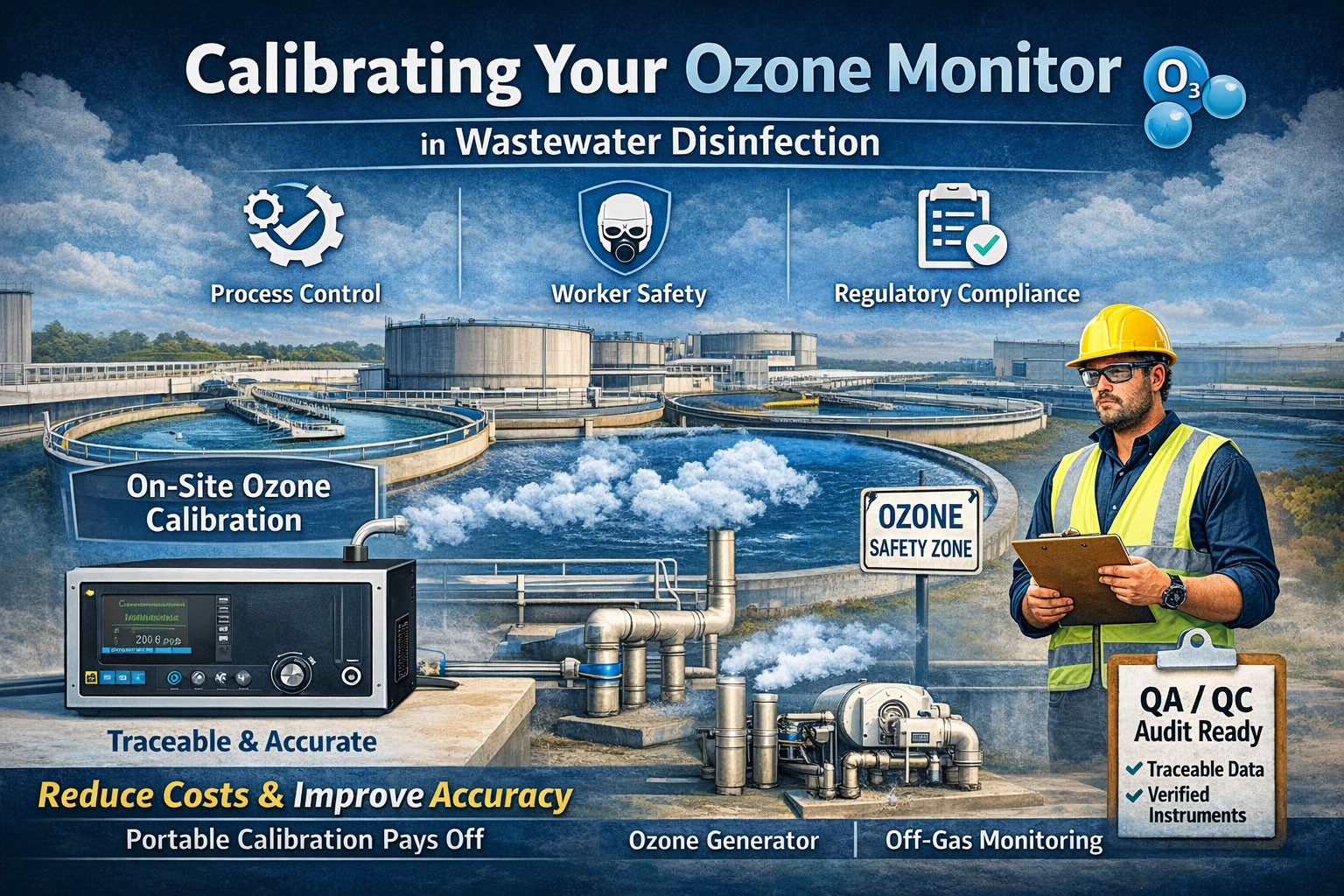
Why Calibrating Your Ozone Monitor Matters in Wastewater Disinfection
Why Calibrating Your Ozone Monitor Matters in Wastewater Disinfection
Ensuring process efficiency, worker safety, and regulatory confidence
Introduction
In modern wastewater disinfection, ozone is widely recognized for its high oxidative power, rapid pathogen inactivation, and absence of chlorinated by-products. However, the effectiveness and safety of ozonation systems depend entirely on the accuracy of ozone measurement.
For municipal utilities and industrial operators, ozone monitor calibration is not a best practice — it is a necessity. Inaccurate measurements can lead to under-disinfection, excessive energy consumption, accelerated equipment wear, or increased occupational risk. This article explains why calibration matters, what traceable calibration really means, and why onsite ozone calibration is increasingly adopted by advanced wastewater facilities across Canada.
Why ozone monitor calibration is mission-critical
Process control and disinfection performance
Ozone disinfection relies on precise dose control.
-
Underdosing increases the risk of pathogen breakthrough and regulatory non-compliance.
-
Overdosing results in unnecessary power consumption, higher operational costs, and potential damage to seals, gaskets, and contactor materials.
Only properly calibrated ozone monitors allow operators to maintain stable, reproducible ozone setpoints throughout changing hydraulic and load conditions.
Worker safety and off-gas monitoring
Ozone is highly effective — but also hazardous at elevated concentrations.
Ambient ozone monitors are essential around:
-
contact basins,
-
off-gas destruction units,
-
generator rooms and pipe galleries.
Calibration ensures that alarm thresholds are meaningful, ventilation systems are validated, and staff exposure limits are reliably enforced.
Regulatory and audit readiness
Environmental audits increasingly focus on measurement traceability, documentation, and uncertainty control.
A calibrated instrument with documented verification intervals provides:
-
defensible data,
-
confidence during inspections,
-
alignment with recognized measurement standards.
What “traceable calibration” actually means
Traceable calibration establishes a documented, unbroken chain between field measurements and a recognized national reference.
In ozone measurement, this chain ultimately originates from national reference photometers, and is transferred through controlled calibration standards with defined uncertainty budgets. For operators, this means:
-
calibration results are repeatable and comparable,
-
measurement drift is detected early,
-
long-term trending remains meaningful.
Without traceability, ozone data may appear precise — but cannot be trusted over time.
Why onsite calibration is replacing offsite service
Many wastewater facilities are moving away from shipping analyzers to third-party labs. Instead, they are deploying portable ozone calibration sources directly on site.
Key advantages include:
-
Reduced downtime
Critical analyzers remain installed and operational. -
Lower total cost of ownership
Elimination of shipping, rentals, and spare inventory. -
Improved consistency across instruments
Ambient, off-gas, and process monitors are all calibrated against the same reference. -
Simplified maintenance planning
Calibration becomes part of scheduled plant maintenance rather than a logistical project.
A practical solution: portable ozone calibration sources
Modern portable ozone calibrators are designed to generate stable, selectable ozone concentrations suitable for calibrating workplace, safety, and process monitors.
Typical capabilities include:
-
ppb-level ozone generation for ambient monitoring,
-
UV photometric reference measurement,
-
controlled flow and concentration stability,
-
compatibility with multiple analyzer types.
Such instruments enable utilities to maintain full internal control over their ozone QA/QC strategy.
Field experience: large-scale municipal wastewater application (Canada)
A major Canadian municipal wastewater utility operating one of the world’s largest ozonation facilities has adopted onsite ozone calibration as a standard practice.
By harmonizing calibration across:
-
ambient safety monitors,
-
process ozone analyzers,
-
off-gas monitoring points,
the utility reports:
-
reduced reliance on external calibration services,
-
faster maintenance turnaround,
-
improved agreement between instruments,
-
increased confidence in both safety limits and disinfection performance.
This approach illustrates how measurement quality directly supports operational excellence in large-scale ozone disinfection systems.
Practical calibration checklist for wastewater facilities
To build a robust ozone calibration program:
-
Define and document the traceability chain used on site
-
Establish verification intervals aligned with risk and usage
-
Calibrate all relevant measurement points (process, off-gas, ambient)
-
Record as-found / as-left values for trend analysis
-
Train personnel and maintain calibration records for audits
A disciplined calibration strategy transforms ozone measurement from a potential weak point into a controlled, auditable asset.
Conclusion
Ozone remains one of the most powerful tools for wastewater disinfection — but only when measurement accuracy is guaranteed.
Regular, traceable, onsite calibration of ozone monitors:
-
protects staff,
-
stabilizes disinfection performance,
-
reduces operating costs,
-
strengthens regulatory confidence.
For Canadian municipalities and industrial wastewater operators, bringing ozone calibration on site is a strategic upgrade that pays for itself in reliability, safety, and long-term process control.
Linked products


Model 202 Ozone Monitor
