



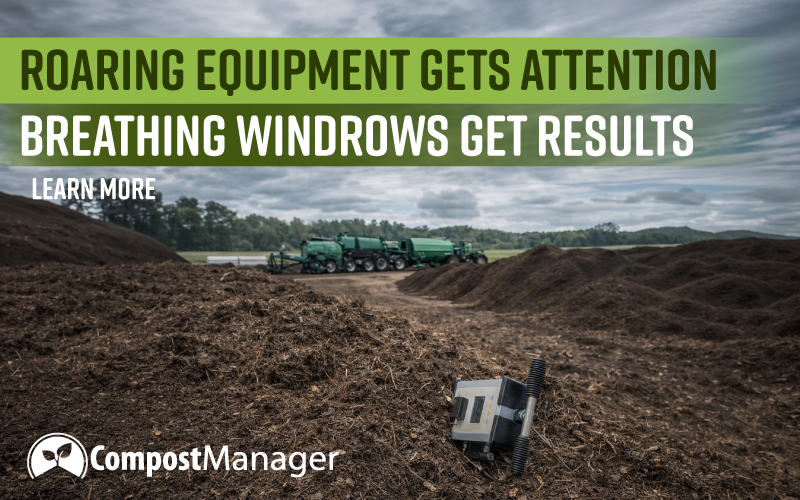
Roaring Equipment Gets Attention. Breathing Windrows Get Results.
In composting operations, high-horsepower shredders, turners, and screens can be impressive to watch. Some machines now operate at up to 912 HP. The power is real, and this type of machinery has its place. But composting is not a mechanical contest. It is a biological process, and performance depends on how well the process is managed inside the windrow.
At a Glance
Composting is biological
Machinery can process material, but bacteria are the ones doing the actual composting work.
Structure and airflow matter
A windrow must breathe properly so air can move naturally from the base through the mass.
Horsepower does not replace control
You do not create an efficient composting process with engine power alone. You design and manage for biology.
Not every turn is beneficial
Some turns improve oxygen and microbial activity. Others only burn fuel and reduce temperature at the wrong time.
Data removes guesswork
When oxygen, carbon dioxide, moisture balance, and windrow conditions are visible, decisions become clearer.
CompostManager supports action
It helps determine whether to turn, irrigate, act immediately, or leave the windrow alone.
Composting Is Not a Mechanical Contest
In the field, it is easy to focus on the visible side of composting: shredders, turners, and screens operating at full capacity, with more and more horsepower. Noise wins attention. There is no doubt that this machinery is powerful, and it has a clear role in many operations. However, the composting process itself is not defined by mechanical intensity.
Material can be smashed, ground, squashed, and turned repeatedly, but that is not where composting performance originates. The real objective is to create the right environment for the bacteria. They are the ones doing the work. They come free of charge, they do not clock off early, and they do not ask for overtime.
Structure and Airflow Drive the Process
Good composting depends on structure and airflow. A windrow should breathe like an open fireplace with a good draw. When the structure is right, air is naturally pulled in at the base and moves upward through the mass, in the same way a chimney draws air to keep smoke moving in the right direction.
That behaviour cannot be forced with horsepower alone. You design for it. The most successful composting operations are not necessarily those with the biggest engines running constantly. They are the ones managing the process correctly.
Why Turning Requires Better Timing
Turning remains a vital part of composting, but not every turn has the same effect. Some turns add oxygen, reduce compaction, and kick-start microbial activity. Others do little more than burn fuel and drop temperature, often at exactly the wrong time.
Without data, it is impossible to know the difference. When turning decisions are based only on routine or instinct, an operator cannot clearly determine whether the intervention is helping the process or quietly setting it back.
Process Control Changes the Decision-Making
This is where process control changes the conversation. When what is happening inside the windrow becomes visible, decisions become clearer. Instead of guessing, operators can respond to actual compost conditions.
When operators understand oxygen levels, carbon dioxide, and moisture balance, they stop turning simply because it feels like the right time. They turn because the biology indicates that action is needed.
In practice, that decision may mean one of several responses:
- Sometimes it means act.
- Sometimes it means irrigate.
- Sometimes it means leave it alone.
CompostManager2: A Practical Solution for Better Windrow Management
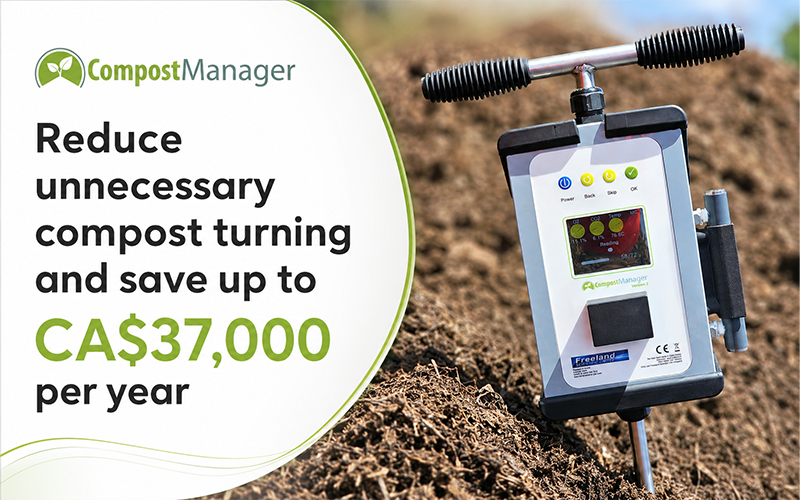
The CompostManager2 is presented as a portable compost analyzer designed to streamline and optimize the composting process. It measures four key parameters in less than one minute: temperature, humidity, oxygen (O2), and carbon dioxide (CO2). This gives operators direct visibility into conditions inside the windrow and helps eliminate the approximations associated with aerobic composting and oxygen measurement in compost.
According to the product presentation, the CompostManager2 is delivered ready to use with a 1.35 m probe and complete cloud-based software. The software analyzes sampling data using an algorithm and provides simple instructions to optimize the composting process, including whether the windrow should be turned, irrigated, or left alone.
The product page also highlights wireless data retrieval, allowing data to be downloaded without any physical connection and viewed while working outside in open windrows. In addition, the CompostManager2 is described as complying with British standards PAS100 and BAT36.
From a construction standpoint, the CompostManager2 is described as solid and robust, with a marine-grade stainless steel and corrosion-resistant casing designed for durability and ease of handling. The listed advantages also include reduced odor impact, reduced production costs, increased composting site productivity, and recorded data for PAS100.
Reducing Unnecessary Machinery Use
Better process control reduces unnecessary machinery use, saves fuel, and improves consistency, while also proving that the windrow is operating as it should. It also helps avoid interventions that can do more harm than good to the composting process.
Turning will always remain an important tool in composting. The real question is whether that turning is driving the process forward or interrupting it at the wrong moment.
912 HP Is Impressive. Managed Biology Is More Powerful.
912 HP is impressive. Large equipment will always attract attention in the field. But in composting, the stronger advantage comes from understanding and managing biology properly. When the windrow is structured correctly, breathing correctly, and monitored correctly, the process is no longer driven by assumption. It is controlled based on what the compost actually needs. That is where process performance becomes more consistent, more efficient, and more meaningful than horsepower alone.
Linked products

