




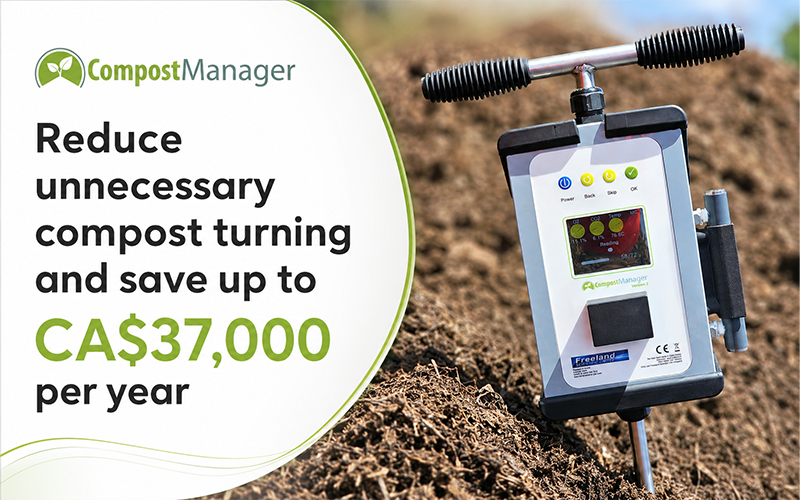
How CompostManager helps reduce unnecessary compost turning
Routine compost turning can represent a significant operating cost. Every unnecessary pass adds fuel consumption, machinery hours and labour, while also contributing to repair and maintenance requirements.
CompostManager replaces routine turning schedules with software-guided process control. Using a purpose-built algorithm, it analyses temperature, moisture content, oxygen and carbon dioxide measurements together and provides operators with clear guidance to Turn, Irrigate or Leave Alone.
At a glance
Data-guided process control
Replace routine turning schedules with decisions based on actual composting conditions.
Four process parameters
Temperature, moisture content, oxygen and carbon dioxide measurements are analysed together.
Clear operational guidance
Operators receive practical recommendations to Turn, Irrigate or Leave Alone.
30% turning reduction example
The Canadian ROI example evaluates the impact of reducing unnecessary turning by 30%.
225 fewer machine-hours
In the illustrative example, annual operating time falls from 750 to 525 hours.
Up to CA$37,000 per year
Potential combined savings include fuel, labour, repair and maintenance costs.
Move from routine schedules to process-based decisions
CompostManager is designed to help operators determine whether intervention is actually required rather than turning according to a predetermined schedule. Its software analyses several key process measurements together to provide simple, practical guidance.
- Temperature
- Moisture content
- Oxygen
- Carbon dioxide
Based on these measurements, the software provides one of three operational recommendations: Turn, Irrigate or Leave Alone. The objective is to reduce unnecessary interventions while maintaining an efficient composting process.
Why unnecessary turning matters for Canadian operators
Each windrow turn requires fuel, machinery time and labour. In the Canadian ROI example, a windrow turner consumes 36 litres of diesel per hour, making every unnecessary operating hour a measurable expense.
The analysis uses CA$2.00 per litre as a conservative illustrative diesel price. The underlying figures indicate Canadian national average retail diesel prices of approximately CA$1.93 to CA$2.29 per litre during July and August 2026, with provincial variations.
The ROI document also notes that the federal carbon levy reached CA$95 per tonne CO2e on April 1, 2026, representing approximately CA$0.21 per litre at point of sale. Actual fuel costs will vary by province, fuel type and purchasing method.
What could a 30% reduction in unnecessary turning represent?
The illustrative example is derived from operational analysis across participating composting facilities. It starts with a windrow turner operating 750 hours per year and consuming 36 litres of fuel per hour.
| Operating parameter | Current operation | After 30% reduction |
|---|---|---|
| Windrow turner operating hours | 750 hours/year | 525 hours/year |
| Fuel consumption | 36 litres/hour | 36 litres/hour |
| Annual fuel usage | 27,000 litres | 18,900 litres |
| Illustrative diesel cost | CA$2.00/litre | CA$2.00/litre |
| Annual fuel cost | CA$54,000 | CA$37,800 |
| Annual machine-hours avoided | — | 225 hours |
| Calculated fuel saving | — | CA$16,200/year |
In this example, reducing unnecessary turning by 30% removes 225 machine-hours per year and reduces annual fuel use by 8,100 litres.
Fuel is only part of the potential saving
Lower fuel consumption is only one component of the potential ROI. Reducing windrow turner operating hours can also reduce the labour required for turning operations and the repair and maintenance costs associated with machinery use.
For the illustrative Canadian calculation, labour is costed at CA$50 per hour fully loaded, while repair and maintenance are estimated at CA$40 per machine-hour. Applied to the 225 machine-hours avoided, the document presents the following potential savings:
| Cost category | Potential annual saving |
|---|---|
| Fuel | CA$16,500 |
| Labour | CA$11,500 |
| Repair and maintenance | CA$9,000 |
| Total potential saving | CA$37,000/year |
The operational calculation above gives a fuel saving of CA$16,200 per year. The combined savings summary in the ROI document uses a rounded fuel saving of CA$16,500 as part of the CA$37,000 total potential saving.
Every composting site is different
The figures above are illustrative rather than site-specific quotations. Actual savings will depend on the characteristics and operating practices of each composting facility.
- Site size
- Machinery and fuel consumption
- Feedstock
- Fuel price
- Current turning practices
- Labour costs
- Repair and maintenance costs
The CA$2.00 per litre diesel cost is an illustrative figure. Marked or off-road diesel and bulk delivery can be lower than retail pump prices, so operators should substitute their own delivered fuel cost when estimating site-specific ROI.
The ROI figures are current as of August 2026 and should be adjusted to reflect each facility’s actual operating costs.
Use process data to decide when to turn
The principle behind CompostManager is straightforward: reducing unnecessary turning reduces operating costs. Instead of automatically deploying machinery according to a routine schedule, operators can use process measurements to determine when intervention is required.
By bringing temperature, moisture content, oxygen and carbon dioxide data together into clear operational guidance, CompostManager helps operators make informed decisions about when to Turn, Irrigate or Leave Alone.
Don’t turn on a schedule.
Turn when your data tells you to.
Contact ES Canada to learn more about CompostManager and discuss how its data-guided approach can be evaluated for your composting operation.
Linked products

