

Professional EMF meters, probes and continuous monitoring systems
ES Canada is pleased to announce the addition of Wavecontrol to its portfolio of environmental, industrial and laboratory instrumentation solutions.
Wavecontrol designs professional instruments for electromagnetic field measurement, exposure assessment and continuous EMF monitoring. For technical teams already monitoring air quality, water, weather, gases or industrial environments, EMF measurement adds another critical layer of environmental and occupational safety data.
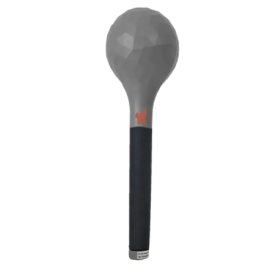
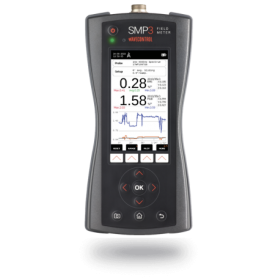
The range includes portable EMF meters, isotropic E-field and H-field probes, wearable personal monitors, RF mapping systems and 24/7 monitoring stations, supporting applications from field measurements to fixed-site surveillance and laboratory validation.
At a glance
Environmental monitoring
Add EMF data to broader environmental monitoring programs alongside air, gases, water, weather and site conditions.
Occupational safety
Evaluate worker exposure using personal monitors, alarms and datalogging for traceable safety records.
Continuous monitoring
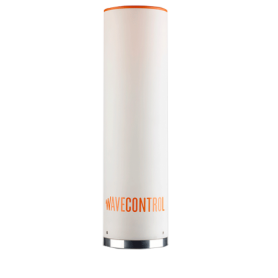
MonitEM, MonitEM-IoT and MonitEM-Lab support long-term indoor, outdoor, industrial and laboratory EMF surveillance.
Laboratory validation
Isotropic probes, True RMS measurement and FFT analysis support reliable testing, validation and reporting.
Connected field instrumentation
MonitEM-IoT enables connected EMF monitoring via LTE-M/NB-IoT or Ethernet/PoE for remote field deployments.
Technical reporting
Calibration, datalogging and measurement repeatability help technical teams document EMF levels with confidence.
Fundamentals of Electromagnetic Fields and Safety Standards
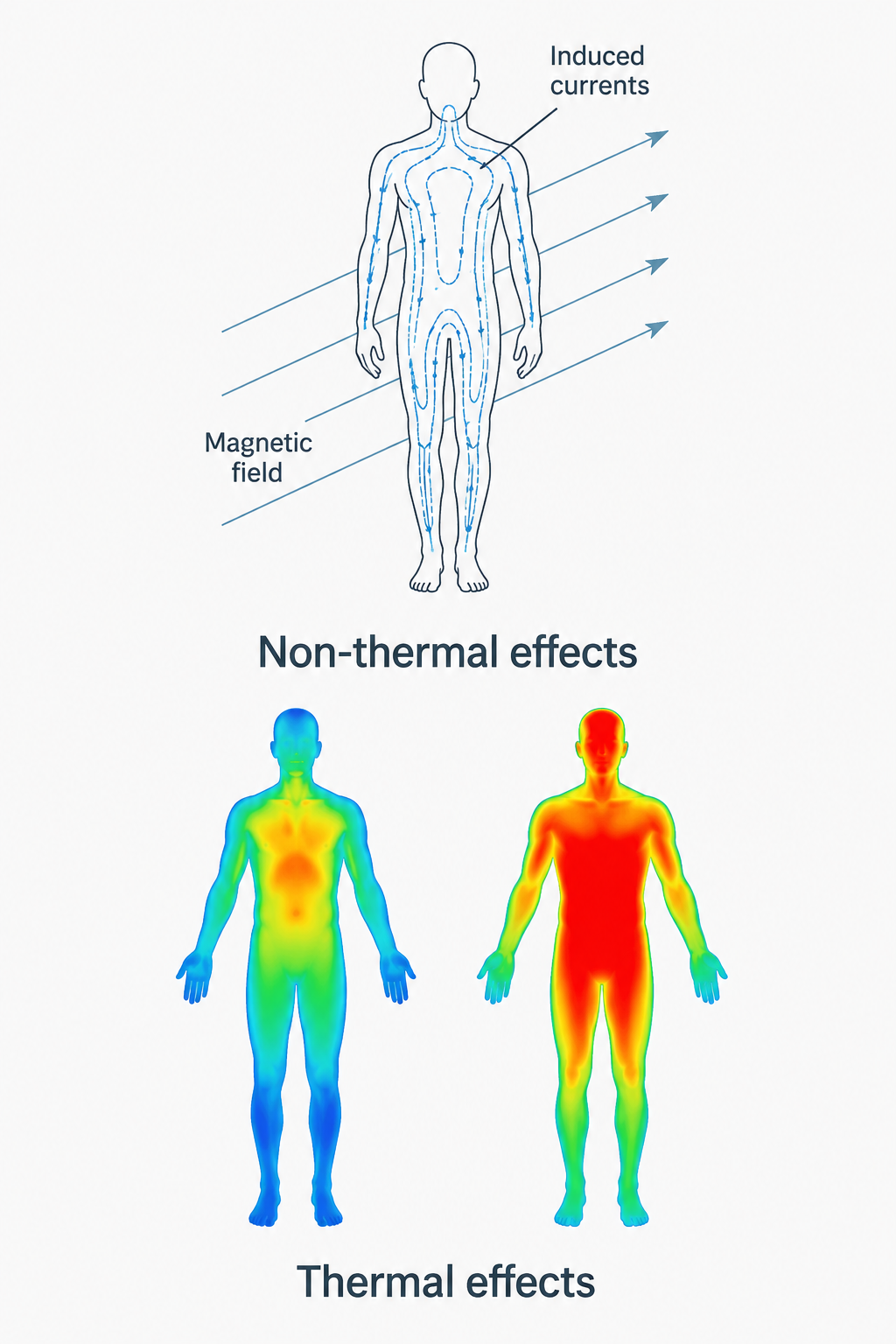
Assessing exposure to non-ionizing electromagnetic radiation requires a clear understanding of the main interaction mechanisms. These mechanisms are classified into two major groups: non-thermal effects and thermal effects.
- Non-Thermal Effects (1 Hz to 10 MHz): Non-thermal effects occur from 1 Hz to 10 MHz and are mainly associated with the electrostimulation of nerves and muscles. These effects can be direct or indirect and are especially relevant for users of active implanted medical devices, who are subject to specific limits. In complex field environments, the Weighted Peak Method is preferred, as it considers both the amplitude and phase of spectral components, allowing direct comparison with exposure limits.
- Thermal Effects (100 kHz to 300 GHz): Thermal effects occur between 100 kHz and 300 GHz and are linked to energy absorption and temperature increase. Above approximately 6 GHz, absorption becomes more superficial, concentrating on the skin and dermal layers. However, heat can be transported through vascular networks, potentially increasing core body temperature. For this reason, time-averaged measurements remain the reference approach for high-frequency assessments.
There is an overlap region from 100 kHz to 10 MHz in which both effects may occur simultaneously. When working within this bandwidth, the evaluation must consider limits for both effects.
Standards addressing this issue are divided into two categories: emission standards, also known as product standards, and exposure standards.
- Emission standards limit the EMF emitted by a device and specify the associated measurement procedures. Organizations such as the FCC or the IEC publish these standards.
- Exposure standards define limits intended to protect people from overexposure. Organizations such as ICNIRP or IEEE publish these standards.
Exposure limits are defined for two main groups: Occupational Exposure, for trained personnel in controlled environments, and the General Public, with an extra safety factor covering individuals with implanted medical devices.
Supporting RF exposure compliance in Canada
In Canada, Health Canada’s Safety Code 6 defines human exposure limits for radiofrequency electromagnetic energy in the 3 kHz to 300 GHz frequency range. These limits are intended to protect people from established adverse health effects associated with RF exposure and apply to individuals working in or visiting locations regulated by the federal government. Health Canada also specifies that these guidelines may be adopted by provinces, industry or other organizations, making them an important reference for many environmental, industrial, laboratory and occupational safety programs.
Safety Code 6 distinguishes between controlled environments, where RF field levels are properly characterized and people are informed and trained, and uncontrolled environments, where access may include the general public or personnel without specific RF safety awareness. For technical teams, this reinforces the need to measure and document electromagnetic field levels with reliable instruments, especially when evaluating worker exposure, public-access areas, sensitive sites or long-term monitoring locations.
Wavecontrol instruments support this compliance-oriented approach by helping users measure, monitor and record EMF exposure data in the field, indoors, in laboratories or across fixed monitoring points. Portable EMF meters, isotropic probes, personal monitors and continuous monitoring stations can contribute to exposure assessment, traceable reporting and informed risk management, in line with the technical rigour expected for environmental and occupational safety monitoring in Canada.
Why EMF monitoring belongs in environmental measurement programs
Environmental monitoring is no longer limited to conventional parameters such as air quality, gases, water quality or meteorological data. In many technical environments, electromagnetic fields are part of the site conditions that need to be measured, understood and documented.
Adding EMF measurement to a monitoring program gives teams a more complete view of the environment around a site, process, laboratory or infrastructure. Wavecontrol instruments help integrate electromagnetic field data into broader environmental assessments, without separating EMF exposure from the rest of the monitoring strategy.
Environmental monitoring: adding EMF as a measurable parameter
For ES Canada customers already working with environmental data, EMF monitoring can be approached as an additional measurement layer. Electromagnetic fields can be monitored alongside air quality, gases, water, weather and site conditions, helping teams build a broader technical profile of their environment.
This approach is particularly relevant when measurements must be repeated over time, compared across locations, or integrated into a structured monitoring campaign. Portable meters, probes and continuous monitoring stations provide different levels of flexibility depending on whether the need is a spot measurement, a survey, or permanent surveillance.
Occupational safety: evaluating worker exposure
In industrial, laboratory and technical environments, electromagnetic exposure may need to be evaluated and documented as part of occupational safety procedures. Wavecontrol personal monitors, alarms and datalogging functions help teams assess worker exposure to electromagnetic fields and maintain traceable safety records.
Wearable EMF monitors are particularly useful when personnel move through different areas or work near equipment where field levels may vary depending on operating conditions. Alarms and recorded measurements support practical field decisions and post-measurement review.
Continuous monitoring: from field surveillance to indoor environments
Continuous EMF monitoring is aligned with ES Canada’s broader expertise in long-term measurement solutions. Systems such as MonitEM, MonitEM-IoT and MonitEM-Lab support indoor, outdoor, industrial and laboratory EMF surveillance.
These solutions are suited to applications where a single measurement is not enough. Long-term monitoring helps follow variations over time, identify changes in site conditions and provide documented data for environmental, safety or technical reporting.
Laboratory and industrial applications: measurement, validation and reporting
Laboratory and industrial teams often require more than a basic field value. They need measurement repeatability, clear documentation and confidence in the instrument configuration. Wavecontrol instruments address these requirements with isotropic probes, True RMS measurement, FFT analysis and ISO 17025 calibrations.
These technical features support controlled measurements, equipment validation, field investigations and reporting workflows where data quality is essential. For industrial environments, they also help document electromagnetic field levels around equipment, processes or defined work areas.
Connected field instrumentation: EMF monitoring for Environmental IoT
Connected instrumentation is central to modern environmental monitoring. With MonitEM-IoT, Wavecontrol extends EMF monitoring into connected field applications using LTE-M/NB-IoT or Ethernet/PoE communication options.
This makes the solution relevant for Environmental IoT projects requiring remote access, long-term deployment and communication-ready monitoring devices. It allows EMF data to be handled as part of a connected monitoring strategy, alongside other environmental parameters.
A technical range for portable, personal and fixed EMF measurement
| Wavecontrol solution | Main technical role | Typical ES Canada application |
|---|---|---|
| Portable EMF meters | Field measurement, exposure assessment and technical diagnostics | Environmental surveys, industrial site assessments, laboratory checks |
| Isotropic E-field and H-field probes | Accurate field measurement independent of field orientation | Measurement validation, industrial investigations, technical reporting |
| Personal monitors | Worker exposure monitoring with alarms and datalogging | Occupational safety, maintenance operations, technical work areas |
| Continuous monitoring stations | 24/7 EMF surveillance over time | Outdoor sites, indoor monitoring, laboratories, sensitive areas |
| Connected EMF monitors | Remote data access through LTE-M/NB-IoT or Ethernet/PoE | Environmental IoT, long-term field deployment, remote monitoring projects |
ES Canada support for EMF measurement projects
Selecting an EMF measurement solution depends on several technical factors: field type, frequency range, monitoring duration, portability, communication requirements, exposure assessment needs and reporting expectations.
By adding Wavecontrol to its portfolio, ES Canada strengthens its ability to support customers who need to measure, monitor and document electromagnetic field levels with the same technical rigour applied to air, water, gas, weather and environmental parameters.
Need to integrate EMF monitoring into your environmental, safety or laboratory program?
Contact ES Canada to identify the right Wavecontrol solution for your site, measurement campaign or connected monitoring project.