



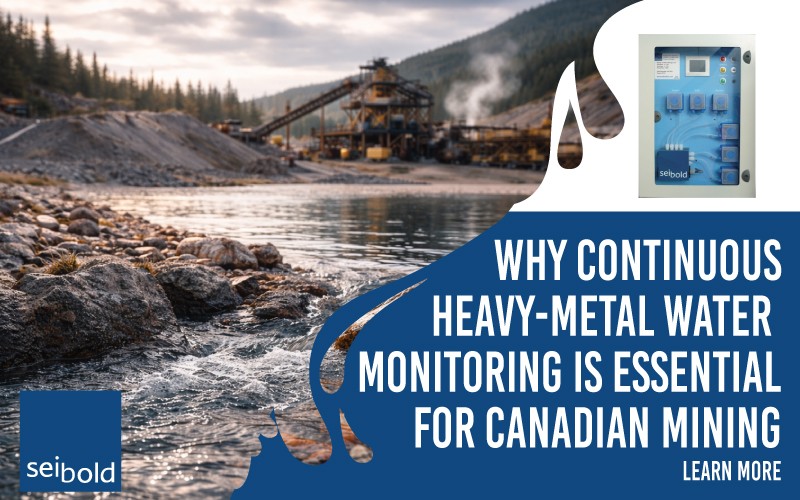
Why continuous heavy-metal water monitoring is essential for Canadian mining
"While laboratory measurements give you some information about the process, online measurements will tell the complete story."
At a glance
24 / 7
Unattended continuous operation — no technician required on site.
5 ppb
Lower measurement limit for most heavy-metal parameters.
1 ppb
Detection limit achieved for arsenic.
The Blind Spot in Industrial Water Management
Canada's mining and heavy-industry sector operates within some of the world's most stringent environmental frameworks. From Quebec's Côte-Nord to British Columbia's northwest, facilities are legally bound to demonstrate that heavy metals — iron, nickel, chromium, lead, copper, arsenic and others — do not exceed prescribed concentrations in discharged water. The conventional approach to meeting this obligation has long relied on periodic laboratory sampling: technicians collect water samples at scheduled intervals, ship them to an accredited laboratory, and await results that may arrive days later.
On the surface, this appears rigorous. In practice, it leaves an enormous blind spot. A process upset that causes a nickel spike at 3 a.m. on a Tuesday, or an iron exceedance that resolves itself by the following afternoon, will never appear in a weekly grab sample. The data point is simply absent — and with it, any chance of understanding, correcting, or documenting what happened.
This is the fundamental problem that continuous online water analysis is designed to solve. And it is a problem that Austrian-based engineering company Seibold Wasser has made the core of its mission: manufacturing online analysers for the unattended, continuous measurement of heavy metals in water, designed specifically for the demanding realities of industrial environments.
"At Seibold, measurement is never about 'can or can't' — it is about how." Seibold Wasser
The Canadian Context
- Quebec and federal effluent regulations impose strict heavy-metal limits on mine discharges.
- Indigenous environmental oversight rights are expanding across all major mining jurisdictions.
- ESG investor expectations increasingly favour verified, continuous data over periodic sampling.
- Canada produced over 125,000 tonnes of nickel concentrate in 2024, ranking 4th globally.
- Sept-Îles alone ships millions of tonnes of iron ore annually to global steel markets.
Technology snapshot
- Method: Spectrophotometric colorimetric analysis (WHO-endorsed for online use), enhanced with kinetic measurement and flow injection analysis.
- Reagents: Proprietary, non-toxic, non-hazardous — safe for unattended industrial operation.
- Validation: Results correlated against simultaneous laboratory reference analysis, including extended uranium field tests demonstrating perfect alignment.
- Maintenance: Automated cleaning, calibration and dilution cycles. Designed for maximum uptime in remote and harsh environments.
What Makes Online Measurement Different — and Difficult
The challenge of bringing laboratory-grade heavy-metal analysis into continuous field operation is not trivial. A peer-reviewed study published in Nature in 2021 highlighted precisely this tension: colorimetric methods — the analytical backbone of heavy-metal detection endorsed by the World Health Organization — are reliable and accurate under laboratory conditions, but continuous online deployment introduces a cascade of complications: matrix interferences, reagent instability, fouling, and signal drift over time.
Seibold Wasser addressed these limitations not by working around them, but by rethinking analyser design from first principles. Their COMPOSER analyser series applies flow injection analysis, kinetic measurement, and photo-spectral evaluation to reduce system complexity while increasing signal clarity. Crucially, the company's approach to reagent chemistry is proprietary and purpose-built for online use: unlike laboratory reagents, which can include hazardous compounds handled by trained professionals, all Seibold reagents are non-toxic and non-hazardous — a practical necessity for instruments that operate unattended in plant environments.
The kinetic measurement dimension is particularly significant. By analysing the speed at which a colour complex forms — not just the final colour intensity — the system can eliminate common interferences, validate measurement quality in real time through what the company calls "fingerprint matching," and resolve multiple parameters from a single reaction. The result is a measurement that is both more reliable and more informative than a static colorimetric reading.
Key parameters covered by Seibold Wasser online analysers
- Iron and manganese (separate and combined).
- Nickel, copper, chromium (Cr III and Cr VI in a single step), cobalt, zinc.
- Lead, cadmium, arsenic (detection at 1 ppb).
- Uranium (validated against laboratory reference in extended field testing).
- Cyanide (relevant to gold and coke production).
The Power of Continuous Data — A Real-World Demonstration
Perhaps the most compelling argument for continuous monitoring is not technical but visual. Seibold Wasser has documented a case study from a Canadian industrial facility — a nickel measurement campaign spanning several weeks in the summer of 2018 — that illustrates the point with unusual clarity.
The data set, gathered at two-hour measurement intervals over roughly three weeks, produced a continuous concentration trace that a process engineer was able to examine in full. The response was immediate: the engineer recognised, at a glance, the reasons for an unstable process that had previously been opaque. The pattern visible in continuous data — fluctuations, spikes, recovery curves — was simply not recoverable from periodic grab samples taken at fixed intervals. Once the source of instability was identified, corrections could be made, improvements documented, and performance verified over time.
This is the insight that the company has distilled into a memorable phrase: online measurements tell the complete story. Laboratory measurements give fragments. For a process engineer responsible for both production quality and environmental discharge limits, the difference between a fragment and a complete story is the difference between reactive crisis management and confident, proactive control.
"The process engineer immediately recognised the problem and could stabilise the process. A stable process leads to higher quality and less consumables." Seibold Wasser — field documentation, Canada, 2018
Adoption at the Highest Level of Canadian Industry
The credibility of any environmental monitoring technology is measured not only by its engineering specifications but by the calibre of the operators who choose to deploy it. In this regard, the adoption of continuous online water monitoring technology at a major iron ore port facility on Quebec's Côte-Nord — operated by one of the world's largest mining groups, with operations stretching from Labrador City through to the Sept-Îles marine terminal — speaks for itself.
The deployment, which took place in September 2019, was not incidental. The individual responsible for the environmental management of that facility had, in fact, been thinking about the problem of water monitoring data quality for some time. His perspective captures the shift in mindset that continuous monitoring demands: where periodic sampling produces a handful of isolated data points, a continuous online system produces a rich, time-resolved record — one dense enough that process anomalies, compliance exceedances, and gradual trends all become visible as distinct features in the data, rather than noise or gaps.
This kind of dense, reliable environmental record is precisely what regulators and community stakeholders increasingly expect from resource-sector operators. For a facility handling millions of tonnes of iron ore per year, with discharge obligations under both Quebec and federal environmental law, the ability to demonstrate continuous, verified compliance — rather than periodic, sampled approximation — represents a meaningful step forward in both accountability and operational confidence.
Why Canada, and Why Now
Canada's mining sector is not a monolith. It spans world-class iron ore operations on the Côte-Nord, copper and gold mines across Ontario and British Columbia, nickel smelting complexes in Sudbury, potash extraction in Saskatchewan, and industrial port facilities processing concentrate from remote northern sites. What these operations share is an increasingly demanding regulatory and social licence environment — one in which "we sampled last Tuesday and results were fine" is becoming an insufficient answer to questions about water quality.
Several converging forces are intensifying this pressure. Indigenous communities across Canada are exercising strengthened rights to environmental oversight in their territories. Provincial and federal regulators are tightening effluent quality standards and enforcement capacity. Institutional investors are applying ESG screens that reward verifiable, continuous environmental monitoring over self-reported periodic data. And the global market for Canadian resources increasingly demands sustainability credentials that go beyond compliance minimums.
Specific advantages of continuous monitoring for Canadian operations
- Early warning: Process upsets detected within minutes rather than days, allowing intervention before regulatory thresholds are breached.
- Audit-grade records: Time-stamped, continuous concentration traces provide defensible documentation for regulators and community oversight bodies.
- Process optimisation: Operational teams gain visibility into how reagent use, flow rates, and ore composition affect discharge chemistry in real time.
- Reduced total cost of measurement: Seibold Wasser's TCM model accounts for analyser, reagents, downtime risk, and labour — continuous monitoring frequently outperforms high-frequency grab sampling on a fully-loaded cost basis.
- Seasonal and matrix adaptability: Instruments are validated for complex matrices including tailings ponds, process water, and coastal marine environments where matrix composition varies significantly with season and ore source.
A Partnership Model Suited to Industrial Reality
One of the more distinctive aspects of Seibold Wasser's approach is its explicit acknowledgment that deploying continuous heavy-metal monitoring in a new environment is a development process, not a product installation. Every water matrix is different. A tailings pond in northern Quebec presents a different chemical environment from a port stormwater channel or a mine pit dewatering discharge. Reagent composition, photometric conditions, calibration protocols, and measurement ranges all require adaptation to the specific matrix before results can be validated against laboratory reference data.
The company's deployment methodology reflects this: exploration and matrix review, method adaptation, validation and calibration, on-site implementation and operator training, and ongoing long-term partnership for fine-tuning. This is not a plug-and-play model — it is a collaborative engineering engagement that produces a measurement system genuinely tailored to its environment. For Canadian operators working in remote locations where instrument downtime carries significant operational and reputational cost, the emphasis on analyser uptime as "the most important feature" resonates clearly.
The COMPOSER analysers are also designed for minimal maintenance in challenging industrial settings: automated cleaning, calibration, and dilution cycles reduce the burden on site staff; continuous flow-through design limits fouling; and built-in quality indicators flag anomalies in measurement conditions before they compromise data integrity.
The Regulatory Horizon
Canada's Metal and Diamond Mining Effluent Regulations, and the various provincial frameworks that sit alongside them, currently specify concentration limits for a defined suite of deleterious substances — but they do not uniformly prescribe continuous monitoring as the compliance mechanism. That may be changing. Internationally, regulators in sectors ranging from European industrial wastewater discharge to drinking water treatment are moving toward requirements for real-time monitoring data, particularly for parameters — like heavy metals — where episodic exceedances can cause acute ecological harm.
Canadian mining operators who invest in continuous monitoring infrastructure now are not simply meeting today's requirements more reliably. They are building the data architecture that will be expected — and possibly mandated — by the regulatory frameworks of the next decade. They are also, perhaps more immediately, building the kind of transparent environmental record that distinguishes a responsible operator in conversations with Indigenous rights holders, municipal governments, and the public communities whose waters lie downstream.
The technology exists, it has been validated in demanding Canadian industrial environments, and it has been chosen by some of the most rigorous operators in the global mining industry. For Canadian mines and industrial facilities still relying on periodic grab sampling as their primary environmental compliance mechanism, the question is no longer whether continuous heavy-metal monitoring is feasible. The question is how long they can afford to operate without it.
Linked products


Continuous Nickel (Ni) Analyzer

Continuous Lead (Pb) Analyzer

Continuous Dissolved Copper (Cu) Analyzer

Continuous Arsenic (As) Analyzer

Continuous Aluminium (Al) Analyzer

Continuous Zinc (Zc) Analyzer

Continuous Cadmium (Cd) Analyzer

Continuous Dissolved Chrome (Cr) Analyzer

Continuous Cobalt (Co) Analyzer
